


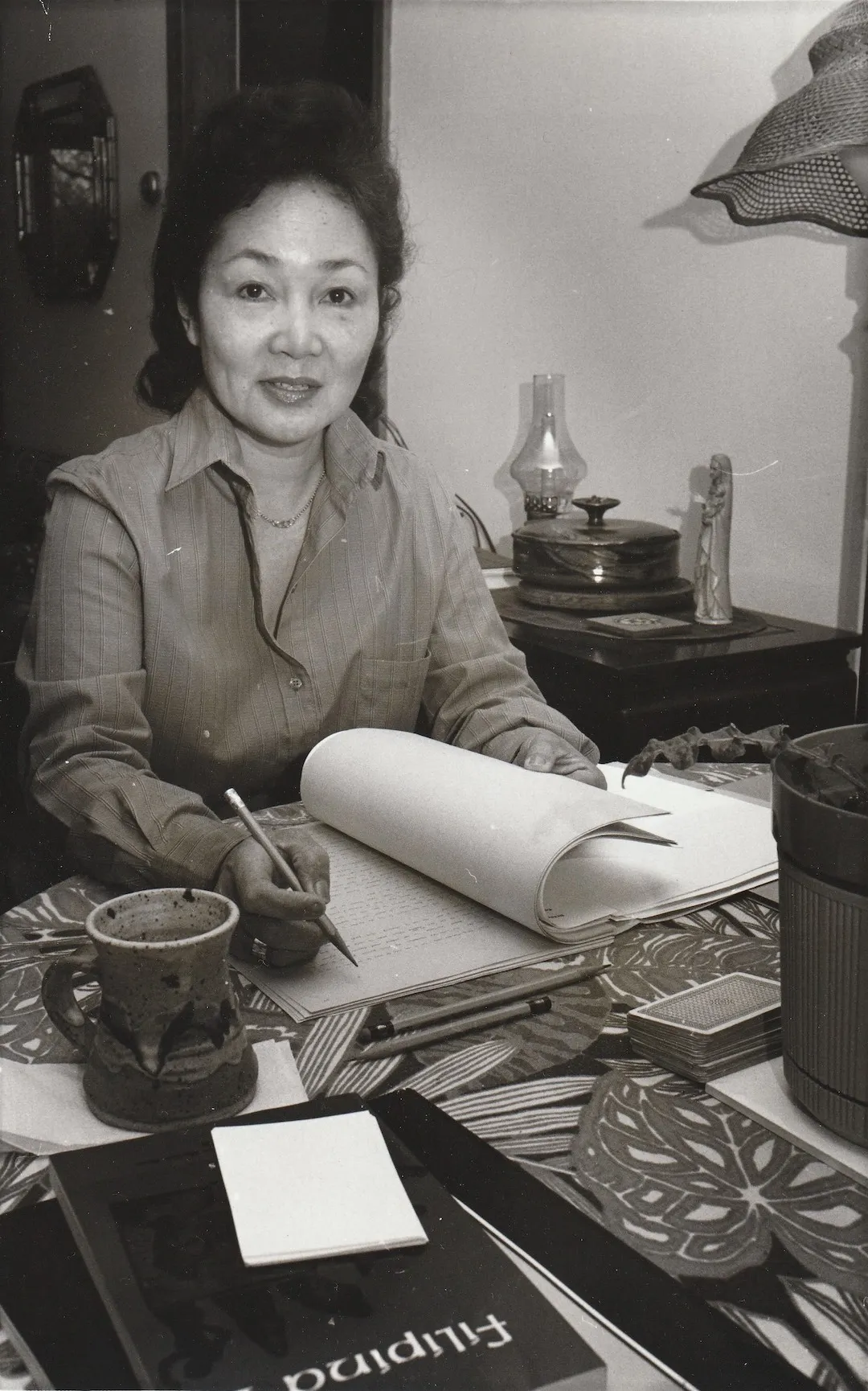
Linda Ty-Casper
Considered among our best Filipino women writers, Linda Ty-Casper has written historical novels from the British Occupation of Manila in 1762 to the Martial Law era. A prolific writer who has just completed her memoirs in 2024, Ty-Casper reminds us to resist forgetting. In this dossier, read about her life, her foreword to The Three-Cornered Sun, her interview with Caroline Hau, and more.
Archival Pieces


Jaime An Lim's "The Three-Cornered Sun: Portraits of the Revolutionary"
The Metastasized Society by Leonard Casper, Firewalkers
Interview on Linda Ty-Casper, from Conversations with Filipino Writers by Roger J. Bresnehan

Profile
“When we were growing up,” Linda Ty-Casper recounted, “Gabriela Paez Viardo de Velasquez told us stories of the Revolution against Spain and of the Philippine-American War. Our grandmother, whom we called Nanay, remembered dogs fighting over bodies left in streets and in yards after the forces retreated. During their flight to escape the fighting, they drank water from rice fields covered with dead bodies and frogs.” “Always, Nanay ended the stories with, ‘Someone should write these.’”
Ty-Casper explains her writing career through her pursuit of such family memories, and through her experience of the daily textures to Philippine history—at home, on the road, and in the archives. “I relived Nanay’s stories when relatives and friends visited, or when we visited them . . . Those visits introduced me to the characters that would bring life to the past Nanay narrated.” “I loved reading about our history. I imagined [that] the old trees, towering over our Caloocan High schoolhouse, had been there when General Antonio Luna waited for the American troops. I could imagine myself being there.” Later, she continued, “Trips allowed me to feel the lay of the land where our history took place. My father, Francisco Figueroa Ty, was an engineer with the Manila Railroad. During vacations, we rode the train to its northern and southern ends, passing other towns where the Revolution and War took place.”[1]
Currently residing in the United States, in Massachusetts, Linda Ty-Casper, one of the foremost figures of Philippine historical fiction, was born in 1931 in Malabon, Philippines. Born Belinda Ty during the American occupation of the archipelago, the prolific writer spent her youth in wartime, enchanted by her grandmother’s stories of revolution and rebellion. She studied law at the University of the Philippines, Diliman, graduating as valedictorian from UP College of Law, and married Leonard Casper, an American literary critic, in 1956. She wrote her first story, “In Time of Moulting Doves,” while waiting for the results of her bar examinations. Leonard and Linda settled in the United States, where she attended Harvard Law School and obtained an MA in international law. “Passing Widener, I decided to check the library out,” Ty-Casper recounted, and “found in D Level West material about the Philippines I had no idea existed: Mrs. William James’s clippings about the Philippine-American War (mislabeled Philippine Insurrection in American textbooks), letters to editors, and soldiers’ letters opposing the War, Anti-Imperialist material . . . I realized that some of the books in the Oceania section had not been taken out at all.” “So instead of writing essays to refute them, I decided that a historical novel would have more impact than another book on the shelf.”
For her writing, Ty-Casper received grants and fellowships from the Radcliffe Institute, the Djerassi Foundation, and the Rockefeller Foundation Bellagio Center, as well as accolades such as the S.E.A. Write Award. Including more than sixteen books, Ty-Casper’s oeuvre is praised for being meticulous in detail and research, all the while grappling with Philippine history. Many also remark at how intimate and truthful, honest in some impossible way, her stories seem. This could be because of how Ty-Casper draws intermingledly from personal history and Philippine history, always seeing the one in the other. Of “In Time of Moulting Doves,” she wrote that she didn’t realize, as she was writing it, the ways in which she was inserting her and her cousin’s experiences into the story, only recognizing their childhood reflections in her narrative much later on when they were pointed out to her.[2]
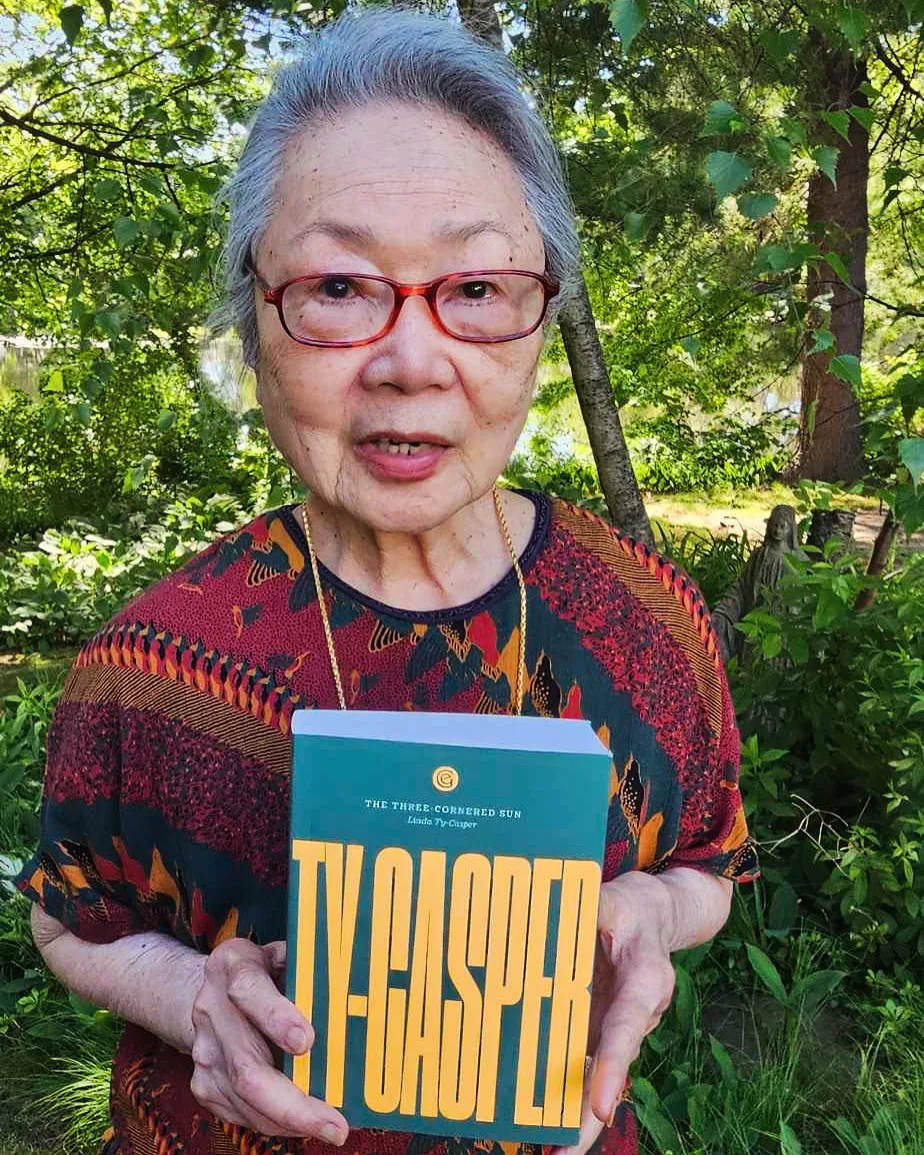
Linda Ty-Casper’s The Three-Cornered Sun tells the story of the Philippines on the eve of revolution against Spain in 1896. Filtered through the recollections of the author’s grandmother Gabriela Paez Viardo de Velasquez, The Three-Cornered Sun follows the lives of the members of the Viardo family as they go through the turbulent times of that tumultuous first year of revolution—sometimes on opposing sides. The book treats not only the unfolding of the history of the revolution, but also its consequences and choices for the people caught up in it. The members of the Viardo family central to this story showcase different dimensions to the national struggle and its predicaments. The Three-Cornered Sun is part of Linda Ty-Casper’s multi-book exploration of the making of the Philippines as a nation through its intimate human peopling and progression through time. As her husband, Leonard Casper, summarized it: “The Peninsulars (1964), centered on the Dutch invasion of 18th-c. Manila, set the thematic pattern of self-injury through divisiveness in her later novels. The Three-Cornered Sun (1979) dramatized how competing Filipino forces during their Revolution of 1896 against Spain so blunted their own effort at independence that . . . the Americans who came later as expected liberators precipitated the Philippine-American War (1899–1901) and remained as colonial overseers.[3] A final novel in the trilogy, The Stranded Whale, about the war’s outcome had already been drafted when she was distracted by President Ferdinand Marcos’s reign of greed and ‘crony capitalism’ (1965–86)."[4]
Linda Ty-Casper began reading for The Three-Cornered Sun, in earnest in February 1963, and by July 1968 she had a first draft that she revised until finishing it in 1974. In 1979, New Day accepted and published the work. “And now, in 2024, you have the Exploding Galaxies edition of The Three-Cornered Sun. I didn’t think there were any new readers for it,” Ty-Casper shared; “I’ve never been widely read, for some reason, but I persisted in writing about us—to fill the absence of our side.”[5]
In place of the imperialist or removed perspectives, Ty-Casper felt she could restore some of the lived reality to this history—“Nanay’s stories began to seem part of the ‘real’ history. It happened to her, I felt it has happened to me.”[6]
The formal construction of the novel mirrors and helps to transmit the narrative content, employing both sequenced thematic character struggles and narrative pacing tracking the progress of the revolution in 1896. The Three-Cornered Sun moves from the meditative individual, spiritual struggles and uncommitted, relaxed ambivalence among Simeon and Blas to the active confrontations and urgency represented in Cristobal and other revolutionaries’ paths.[7] Ty-Casper also occasionally introduces and kills off characters in a single chapter, highlighting the humanities/horrors that war reveals with matched speed. Ty-Casper pairs this progression with geographical itinerancy, which brings dimension to the revolution, communicating the textures of increasingly mass (rather than merely elite or local) action and a growing sense of shared aspirations—the very process of a revolution becoming a revolution, however imperfectly or incompletely. “The effect, therefore,” as Jaime An Lim observed, “is one of inclusiveness, the democratization of point of view, the rhetorical consequence of having the people, the masses, as hero. This strategy can easily result in a disjointed narrative where each character pursues a separate destiny. But a strong unifying influence is provided by the theme of the revolution itself which directly affects all the characters, major and minor, from the most dedicated revolutionary to the most apathetic bystander, like an uncontrollable flood carrying away everything that stands in its path.”[8]
The Three-Cornered Sun is one of our most important works of historical fiction, a genre that remains sparse within Philippine literature. National Artist Franz Arcellana observed that history is the hero of The Three-Cornered Sun. Indeed, Ty-Casper wrote that, “In a sense, literature cannot avoid being historical because it is about life.” She posited that if a country’s history is its biography, then its literature is its autobiography.
“It was only slowly, incrementally,” Ty-Casper reflected, “after the Southeast Asian Writers Award, when a man came up to shake hands after my acceptance speech, and said, ‘Written just like a lawyer’—that I realized that preserving our part of world history in historical novels is a form of advocacy.” “It is defending our country against false depictions; making sure the world does not forget us, that we do not forget who we were, and are; and we can therefore resist ‘occupation’ by foreigners, and by our own countrymen.”[10] Linda once wrote that literature is not the place in which to learn history, but to understand it, and it is in that sense that both our literature and our history remain indebted to her.[11]
-
[1]Linda Ty-Casper, “Writing Historical Novels,” Exploding Galaxies, 9 September 2023, https://www.explodinggalaxies.com/essays/writing-historical-novels.
[2] M.R. Avena, “Meet the ‘most underrated’ but best Filipina fictionist,” Philippine Panorama, 18 March 1979.
[3] This topic Linda Ty-Casper covers in her novel Ten Thousand Seeds (Ateneo University Press, 1987).
[4]Leonard Casper, “TY-Casper, Linda,” in Letter T, Continuum Encyclopedia of American Literature, ed. Steven R. Serafin (Bloomsbury Publishing), 1163.
[5]Ty-Casper, “Writing Historical Novels.”
[6]Carol Hau’s interview with Linda Ty-Casper for Exploding Galaxies (unpublished, forthcoming)
[7] For further development of this, see: Jaime An Lim, “The Three-Cornered Sun: Portraits of the Revolutionary,” Philippine Studies 40, no. 2 (Second Quarter 1992): 255–266, https://www.jstor.org/stable/42633313.
[8] An Lim, “TheThree-Cornered Sun: Portraits of the Revolutionary,” 257–258.
[10] Ty-Casper, “Writing Historical Novels.”
[11] Linda Ty-Casper, “Literature: A Flesh Made of Fugitive Suns.”
2316 Chino Roces Avenue Ext.,
Makati, 1231 Metro Manila
mara@explodinggalaxies.com
