

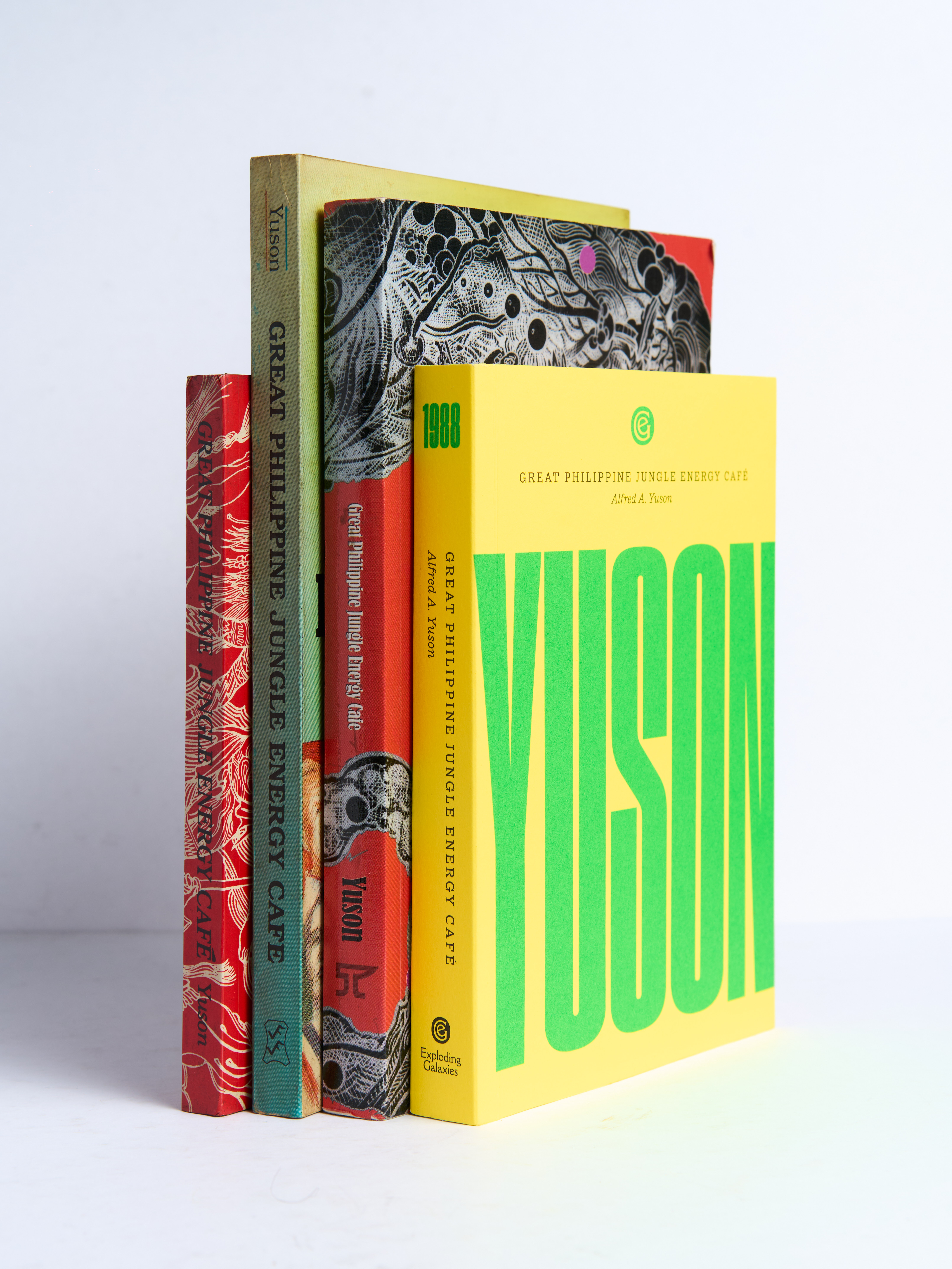
Energy Café is the first novel of Alfred A. Yuson, whom everybody calls Krip for no reason anyone can remember—unless it was that as a jerk he was a creep.
This first novel of Krip’s won the grand prize for the novel in this year’s Palanca awards. He wrote the opus on a grant from the Cultural Center and says it’s due soon for publication.
We’ve been reading Energy Café in manuscript and find it rough, rude, delirious and electrifying. We realize all over again how wrong were the people who said that Joyce took the novel as far as it could go and so Ulysses was the end of it. But how many new things has the novel become since then—and Krip here anthologizes all those novelties.
There is of course lots of the stream-of-consciousness from Joyce but done more wildly. There are goofy disarrangements of time and sequence but even goofier than when Aldous Huxley and Virginia Woolf were experimenting. There’s a giddy playing with words a la Nolledo and a use of close-ups, fade-outs, long-shots and other tricks filched from the cinema. And there’s the E. L. Doctorow way of mixing together real persons and fictional characters that makes this Krip novel a very amusing roman à clef.
But the reader who plows through this welter of bewilderments may cry out in dismay: “But what does it all mean?” And one could beg the question by simply declaring that this novel is a poem and: “A poem should not mean but be.” No such evasion, however, is necessary, because on its own turf the Krip novel makes sense.
In the world it creates, everything is happening under the light of eternity. So side by side occur the Revolution of ’96, the demos of Marcos in the ’80s, and banditry in the boondocks in the days of the Guardia Civil. Visayan scenery in Spanish times will conjure up the Silliman summer workshops of the 1960s, while the career of Leon Kilat is simultaneous with the writing of a screenplay based on his life. The hero becomes a sacristan, who becomes a Singer salesman, who becomes a circus performer, who becomes a revolucionario, is as good a metaphor for the Filipino as any other. But he is not the protagonist of this poem.
The protagonist is the mind, the memory, that shuttles back and forth across the narrative. In that intellect, Rizal is contemporaneous with Jose Garcia Villa; Leon Kilat with the Manila Film Center; and Princess Urduja with Eman Lacaba. It’s the intelligence that is our identity. Not this or that bit but all the bits together. We are the sum of all our contradictions, divorces and anachronisms.
That’s why our meeting place is called the Great Philippine Jungle Energy Café. Krip assembled there King Kasilag and Rio Alma (with James Dean) listening to Teodoro Valencia while General Aguinaldo limps towards the bar and two other generals, Leon Kilat and Carlos Romulo, shake hands as Ishmael Bernal, Gunnar Myrdal, Jorge Arago, Marita Manuel and Nonoy Marcelo watch over a dish of baked mussels and Dr. José Rizal converses at a table with Dr. Ferdinand Blumentritt. All this described in one kilometric peroration that recalls the endless sentence with which Joyce ended Ulysses.
A tour de force is what Krip Yuson has pulled off.
Franz Arcellana has called Energy Café a “good read,” a “good reread,” “a magnificent novel.” And Franz is a master who knows what’s novel.
Maybe we should trumpet that we too knew that Krip had it in him when we picked him in younger days as one of the Young Writers we were betting on, as he well remembers. So, says he: “I like to think I belong in some way to that special company of prospects you had at one time held high hopes for, and that this work could be a partial vindication of those hopes.”
It sure is. Krip-boy, it sure is!
And he adds that it would be his joy to have a “venerable pair of angels—meaning Franz and me!—usher him into the “the fallen world of Philippine novelists.”
It isn’t, Krip-boy, it isn’t fallen. Or if it is, well, hooray that there you are to raise it up again!
Nick Joaquin
1 November 1987
(The preceding is excerpted from an advance review which appeared originally in the 1 November 1987 issue of Sunday Inquirer magazine.)
%203.webp)