

- National Fellow for Fiction, UP Creative Writing Center, 2001
- Third prize in poetry, Palanca Awards, 1971 — "Alayuga's Mountains"
- First prize, Philippines Free Press, 1966 — "Ireland"
- Second prize, Philippines Free Press, 1967 — "The Fairy Child"
- Prizes from the Asia-Philippines Leader, Tagaytay, and ASEAN
Erwin E. Castillo
Still all the lower rebellions and be sure /To mention love's name between / Each other often. And all these /Accomplished, you will know this love / Which (while it will not complete) / Will not destroy; and when you part, / Let your cleaving be tearless and solemn, / Accepting the inevitable, as good skulls do.
- National Fellow for Fiction, UP Creative Writing Center, 2001
- Third prize in poetry, Palanca Awards, 1971 — "Alayuga's Mountains"
- First prize, Philippines Free Press, 1966 — "Ireland"
- Second prize, Philippines Free Press, 1967 — "The Fairy Child"
- Prizes from the Asia-Philippines Leader, Tagaytay, and ASEAN
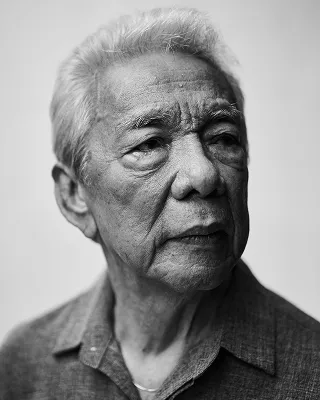
Erwin E. Castillo is a poet, painter, musician, and writer of metafiction, for many years active working in advertising and political communications and as a journalist commenting on culture, history, and sports. He has written rock songs and comic strips, boxed, and taught and practiced Chinese martial arts. He shoots guns and instructs in practical shooting disciplines.
Erwin E. Castillo’s Biography
Born in Manila in 1950, Castillo is married to Ma. Lourdes Claravall with whom he has four sons. He attended Ateneo de Manila University, the University of the Philippines, and University of Iowa, and in 2001 was the UP Creative Writing Center’s National Fellow for Fiction.
As a student, he excelled in elocution, athletics, music, history, natural sciences, painting, and writing. His “Alapaap’s Mountain” won third prize in poetry in the 1973 Carlos Palanca Memorial Awards for Literature.
His short stories “Ireland” and “The Fairy Child” won first prize in 1966 and second prize in 1967, respectively, in the literary contest of the Philippines Free Press. He has also won literary contests sponsored by the Asia-Philippines Leader, Tagayan, and ASEAN.
Writing Career
Castillo wrote The Firewalkers and The Watch of La Diane over twenty years apart; the latter was written in 1971 and published by the Asia-Philippines Leader and the Manila Review, while the former was published in 1992 by Anvil and was serialized in abbreviated form in Philippine Graphic Weekly Magazine.
The Firewalkers was an immediate literary sensation. Cristina Pantoja Hidalgo describes it as exploring Philippine mythical material, joining contemporaries such as Cecilia Manguerra Brainard’s Song of Yvonne in this approach. It employs a postmodern set of language registers and discontinuous narration to depict the fragmentations and carnivalesque quality of modern Philippine life.
The Firewalkers and The Watch of La Diane “have an obvious, warts-and-all family resemblance,” Castillo wrote in 1992, “and a concern for monsters, which may comment on the slowness of my personal progress.” When I asked him what monsters those might be, he explained how innocent he’d been. “I didn’t believe in evil; I was a latecomer…. At Iowa, I read Holocaust survivor stories, and I started to think there was such a thing. Then I came face to face with it here.”
Castillo returned home from Iowa, and “You know Pinoys, we’re so friendly. I thought we were all friends. But such kinship, if given certain contexts and reasons, is so quickly forsaken.” “Your brother who you know and drank with, was going to kill you. I saw friends murdered by friends and evil was suddenly a reality. People I’ve known since they were children, I’ve had to bury.”
About The Firewalkers
The Firewalkers takes the fairy tale as a mode. “Set in the fictional town of Lakambaga in Castillo’s beloved Cavite, The Firewalkers tells the redemption through fire of Gabriel Diego, descendant of warriors but lackey to occupying forces during the Philippine-American war.”
“In this book,” Paolo Enrico Melendez describes, “Castillo takes the revered and refracts it through the lens of the carnivalesque: Italian epic poem Orlando Furioso becomes a costumed circus actor; revolutionary generals, the stuff of local legend, are embodied in the vanquished Olfato brothers; Diego the central character carries around a riding whip, although there isn’t a scene in the novel in which he mounts a horse.” “It remains in Philippine art as among the best representations of individual reparation amid the collective trauma of occupation,” he concluded.
And Castillo, for his part, remains among the best living writers we’ve got.
His follow-up novel, Cape Engaño, 20 years in the making, was serialized in Esquire Philippines beginning in 2014. “Castillo is myth-maker and hype-master,” Erwin Romulo explained. “Shortly after the release of Firewalkers, he began to speak of a new novel, born during a bawdy all-night booze up in the mystical island of Dumaguete in Negros Oriental. It would tell of seven mystics who ran the world, and the misadventures they have when their regular meeting to determine global affairs is held here in the Philippines.
It would be a titan of a novel, with chapters thousands of words long, featuring a hundred different characters; it would be presented by Castillo to the legendary Nick Joaquin, in recompense for the ‘short’ Firewalkers.”
“I no longer write as I did in my adolescence, where I would change my name and it is me falling in love, etc. It is no longer that,” Castillo explained. ‘Good skulls’ are now gone, which for us, if not for him, is a real loss. Writing has now become to Castillo a kind of mastery of personalities—both one’s own and the world’s many possible ones.
“I liked Hemingway when it was not fashionable to like Hemingway,” Castillo related. “A writer should be a person you can go down the river with. And this was a person that could go down the river.” When Hemingway says the sun is shining or that there are birds or grasshoppers there, they always are. Castillo returned again to Hemingway when Butch Dalisay asked him at an open forum in 2001 at the UP Creative Writing Center about the muscularity of The Firewalkers, about the action that suffuses every page, so unlike the quietude that seemed to mark most of their contemporaries’ novels at the time.
He explained that Hemingway was his teacher, although when he was younger, he did not acknowledge this. Unlike the European writers that were also popular during Castillo’s youth, Hemingway was boorish, rough, and had a popularly perceived anti-mind stance, which was not true, of course.
“And so that was how we wanted to write. We were interested in physical action in our daily lives. We were athletes, and it was fun. And of course (there was) a fascination for violence, even ritual violence, confrontations and such.”
This pervasive sense of something coming, was not just the privilege of youth and its ever-unfurling, unspooling world. Castillo carries it within him even now in old age.
“Writing is amuletic,” he told me, sitting in his study. “Fiction is not irrelevant; it makes things happen.”
“Writers believe magic exists in writing,” he explained. “We have to.”